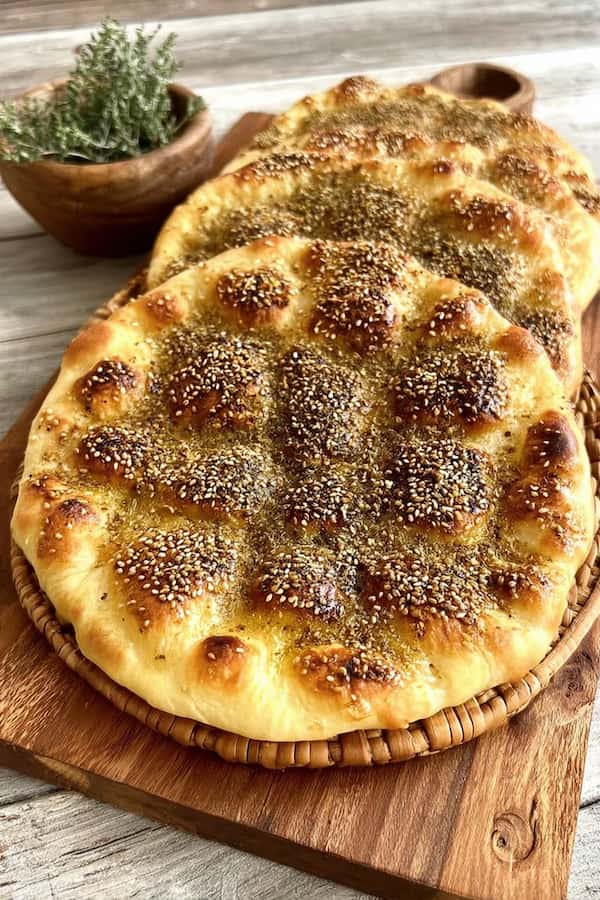
Manakish — also spelled manaeesh or man’oushe — is a Lebanese flatbread topped with a za’atar and olive oil paste and baked until the edges are golden and the topping is fragrant and set.
It’s eaten for breakfast across Lebanon and the wider Levant, often folded in half and eaten warm straight from the oven. This recipe gives you the dough and the topping from scratch, and once you’ve made it at home you’ll understand why it’s a staple.
Ingredients
Makes: 6 manakish (serves 4–6)
For the dough:
- 2 1/4 teaspoons active dry yeast (1 packet)
- 1 teaspoon sugar
- 1 cup warm water (about 110°F)
- 3 cups all-purpose flour, plus more for dusting
- 1 teaspoon salt
- 2 tablespoons olive oil
For the za’atar topping:
- 4 tablespoons za’atar spice blend
- 4 tablespoons extra virgin olive oil
- Pinch of salt
Why You Must Try This Manakish Recipe
Manakish is one of those dishes that’s deeply rooted in everyday life in Lebanon — it’s not special occasion food, it’s what people eat on a Tuesday morning before work. The za’atar paste baked onto a soft, slightly chewy dough is a flavor combination that’s hard to explain until you’ve tried it.
The dough itself is simple enough that it doesn’t require any special skill, and the topping takes about 30 seconds to mix. What makes manakish worth making from scratch is that the dough bakes differently from store-bought pita or naan — it’s thicker in parts, thinner at the edges, and has a texture that comes from being handmade and stretched rather than machine-rolled.
Wake Up the Yeast
Combine the warm water, sugar, and yeast in a large bowl and stir gently. Leave it for 5 to 10 minutes until the surface is foamy and the yeast is visibly active.
If nothing happens after 10 minutes, the water was too hot or the yeast is old — start again with fresh yeast and water at the right temperature. The target is around 110°F, which feels warm but not hot on the inside of your wrist.
This is the same process as the Olive Garden breadsticks recipe, and the same rule applies here: don’t skip the foam check before mixing the dough.
Mix and Knead the Dough
Add the olive oil and salt to the yeast mixture and stir briefly. Add the flour one cup at a time, stirring between each addition until a shaggy dough forms.
Turn it out onto a lightly floured surface and knead for 8 minutes until it’s smooth, soft, and slightly tacky — not sticky. If it sticks to your hands throughout, add flour one tablespoon at a time.
If it’s too stiff, add a small splash of water. Manakish dough should be softer than bread dough — it needs to stretch thin without tearing. Shape it into a ball, place in a lightly oiled bowl, cover with plastic wrap, and leave in a warm spot for 1 to 1.5 hours until doubled.
Make the Za’atar Paste
Mix the za’atar spice blend with the olive oil and a pinch of salt in a small bowl until it forms a spreadable paste.
The ratio of za’atar to oil should be roughly equal by volume — if it looks too dry and crumbly, add a little more olive oil. If it looks too oily and wet, add a pinch more za’atar. The paste should spread easily without running.
Taste a small amount — it should taste herby, slightly nutty from the sesame seeds, and tangy from the sumac in the za’atar. If your za’atar is very mild, a pinch of sumac added directly to the paste sharpens it considerably.
Shape and Top
Preheat your oven to 475°F — as hot as it will go. If you have a baking stone or steel, place it in the oven to heat up.
Otherwise, use an upside-down heavy baking sheet. Divide the risen dough into 6 equal portions. Working with one at a time and keeping the rest covered, roll each portion into a thin round about 7 to 8 inches in diameter.
It doesn’t need to be perfectly circular — slight irregularity is normal and part of the appeal. Spread one to two tablespoons of za’atar paste over the surface of each round, going almost to the edges. Place on a piece of parchment and slide onto the hot surface.
Bake Fast and Hot
Bake each manakish for 6 to 8 minutes until the edges are golden and the za’atar paste looks set and slightly darkened.
The high heat is what gives manakish its characteristic texture — a slightly crisp base with a soft, pillowy interior. Don’t bake at a lower temperature thinking it will be safer — lower heat produces a dry, cracker-like result rather than the soft, yielding texture the bread should have.
Work in batches, baking one or two at a time depending on your oven size. They cool quickly so serve them directly from the oven while still warm.
How to Eat It
The traditional way to eat manakish is to fold it in half or roll it like a wrap with fresh vegetables, mint, and sometimes a smear of labneh inside. The contrast of the warm, herb-covered bread against the cold, fresh fillings is the whole experience. Serve them on a large board alongside sliced tomatoes, cucumber, fresh mint, olives, and a bowl of labneh.
People assemble their own and eat them folded. For a simpler serving, cut each one into wedges and serve as you would pita with dips. Either way, eat them while they’re warm — manakish doesn’t improve with time.
How To Make This Manakish Recipe Better
These changes improve the base recipe or take it in a different direction:
Make your own za’atar blend. Store-bought za’atar varies widely in quality and freshness. For a noticeably better topping, mix dried thyme with toasted sesame seeds, sumac, and salt in roughly equal parts. Toast the sesame seeds first in a dry pan for two minutes for a deeper flavor.
Top with cheese instead of za’atar. Akawi cheese or fresh mozzarella spread over the rolled dough and baked is the cheese version of manakish — called man’oushe jibneh. It’s just as traditional as the za’atar version and works well at the same table.
Cook on the stovetop instead of the oven. Heat a dry cast iron skillet over high heat and cook each shaped, topped round for 2 to 3 minutes until the bottom is golden and the top is set. Cover with a lid for the last minute to trap heat on top. This method is faster and produces a slightly more charred, smoky base.
Cold ferment the dough overnight. After kneading, refrigerate the dough overnight instead of letting it rise at room temperature. A slow cold rise develops more flavor in the dough — the finished manakish will taste more complex than the same-day version.
Combine za’atar and cheese. Spread a thin layer of za’atar paste over the dough and scatter crumbled akawi or feta over the top before baking. The salt from the cheese enhances the za’atar and the combination is more complete than either one alone.
Storage
Manakish is best eaten immediately after baking. The texture changes as it cools — the base goes from soft and slightly crisp to dry and stiff within an hour.
If you have leftovers, wrap them in foil and reheat in a 375°F oven for 4 to 5 minutes, or warm in a dry pan for a minute per side. The unbaked shaped and topped rounds can be refrigerated on a tray for up to 4 hours before baking — useful if you want to prep ahead and bake fresh when guests arrive.
The raw dough also keeps well in the fridge for up to 2 days, tightly wrapped.
What Is Za’atar and Where Do You Buy It?
Za’atar is a Middle Eastern spice blend made from dried thyme or oregano, sesame seeds, sumac, and salt. The name refers both to the spice blend and to the wild thyme plant it’s built around.
The flavor is herby, nutty, and slightly tangy from the sumac. It’s one of the most versatile spice blends you can buy — it works on labneh, eggs, roasted vegetables, hummus, and bread. In the US, za’atar is available at Middle Eastern grocery stores, Whole Foods, specialty food shops, and online retailers.
Quality varies significantly between brands — a fresh za’atar should smell strongly of thyme and have visible sesame seeds. Stale za’atar has almost no aroma and produces a flat, underpowered topping. If you can only find bland za’atar, adding extra sumac and toasted sesame seeds to the paste improves it significantly.
Can You Make Manakish Without a Pizza Stone?
Yes. A pizza stone gives the best base texture because it holds heat well and transfers it directly to the bottom of the dough — but it’s not essential. An upside-down heavy baking sheet preheated in the oven works almost as well.
The key is that whatever surface you use is already hot when the manakish goes on it. A cold baking surface means the dough sits and steams from the bottom before the oven heat reaches it, which leads to a soft, pale base rather than the golden, slightly crisp bottom that manakish should have.
The cast iron stovetop method mentioned in the tips above is actually a reliable alternative to oven baking if you don’t have a stone — the direct heat from the pan is more intense than most home ovens and produces a good result.
Manakish is one of those recipes that connects you to a whole food culture in a single bite. The dough is straightforward, the topping is simple, and the result is something that tastes like it came from a proper Lebanese bakery. Make it once on a weekend morning and serve it the way it’s meant to be eaten — warm, folded, and shared.
Ingredients
Method
- Combine warm water, sugar, and yeast in a large bowl. Stir and leave 5–10 minutes until foamy. If no foam forms, start over with fresh yeast.
- Add olive oil and salt to the yeast mixture. Add flour one cup at a time, stirring between additions until a shaggy dough forms. Turn onto a lightly floured surface and knead for 8 minutes until smooth and soft. Place in a lightly oiled bowl, cover with plastic wrap, and leave in a warm spot for 1 to 1.5 hours until doubled.
- Mix za’atar and olive oil with a pinch of salt until a spreadable paste forms. Add more oil if too dry, more za’atar if too wet. Taste and adjust — add sumac if the blend tastes flat.
- Preheat oven to 475°F with a baking stone, steel, or upside-down heavy baking sheet inside. Divide dough into 6 equal portions. Roll each into a thin round about 7–8 inches in diameter. Spread 1–2 tablespoons of za’atar paste over each round, going almost to the edges.
- Slide manakish onto the hot surface using parchment. Bake for 6–8 minutes until edges are golden and the topping is set and slightly darkened. Work in batches.
- Serve immediately while warm. Fold in half or roll with fresh tomatoes, cucumber, mint, and labneh inside — or cut into wedges and serve with dips alongside.
Notes
- Preheat your baking surface — a cold surface produces a pale, soft base instead of a golden crust
- Don’t bake at a lower temperature — high heat is essential for the right texture
- Stovetop method: cook in a dry cast iron skillet on high for 2–3 minutes, covered for the last minute
- Make ahead: shaped and topped rounds can be refrigerated for up to 4 hours before baking
- Raw dough keeps in the fridge for up to 2 days tightly wrapped
- For the cheese version (man’oushe jibneh): replace za’atar paste with crumbled akawi or fresh mozzarella
- Leftovers reheat in a 375°F oven for 4–5 minutes wrapped in foil