Muhammara is a Syrian roasted red pepper and walnut dip that sits somewhere between a spread and a sauce — warm from Aleppo pepper, slightly sweet from the roasted peppers, and grounded by toasted walnuts and a touch of pomegranate molasses.
It’s one of the most interesting dips you can put on a mezze table and consistently the one people ask about first. If you’ve never made it before, this recipe is the place to start.
Ingredients
Serves: 6–8 as a dip or spread
For the muhammara:
- 2 large red bell peppers (or 1 jar roasted red peppers, about 12 oz, drained well)
- 1 cup walnuts, toasted
- 3 tablespoons breadcrumbs (plain or panko)
- 2 tablespoons pomegranate molasses
- 1 tablespoon lemon juice
- 2 cloves garlic, roughly chopped
- 1 teaspoon Aleppo pepper flakes (or 1/2 teaspoon regular red pepper flakes)
- 1 teaspoon cumin
- 1/2 teaspoon smoked paprika
- 1/2 teaspoon salt
- 3 tablespoons extra virgin olive oil, plus more to serve
- 1–2 tablespoons water (to adjust consistency if needed)
To serve:
- Warm pita or flatbread
- Extra olive oil drizzle
- Chopped toasted walnuts
- A pinch of Aleppo pepper
- Fresh parsley leaves
Why You Must Try This Muhammara Recipe
Most dips rely on one primary flavor — hummus tastes of chickpeas and tahini, guacamole tastes of avocado, labneh tastes of yogurt. Muhammara is different because every ingredient is doing something distinct at the same time. The roasted peppers bring sweetness and body.
The walnuts add fat and a mild bitterness. The pomegranate molasses gives acidity and a faint fruity depth that’s hard to identify but impossible to miss. The Aleppo pepper adds warmth that builds slowly. And the breadcrumbs thicken the texture and give the dip a slightly rustic quality rather than the smoothness of a puree.
No single component dominates — the balance is the point.
Roast the Peppers
If you’re using fresh red bell peppers, roasting them yourself produces a noticeably better result than jarred. Place the whole peppers directly over a gas burner flame on high, turning with tongs every couple of minutes until the skin is charred and black on all sides.
Alternatively, place them on a baking sheet under a broiler at high heat for 20 to 25 minutes, turning once or twice. Once charred, transfer to a bowl, cover tightly with plastic wrap, and leave for 15 minutes.
The steam inside the bowl loosens the skin and makes it easy to peel. Remove the skins, stem, and seeds. Don’t rinse the peppers — you’ll wash away flavor. If using jarred peppers, drain them well and pat dry before using.
Toast the Walnuts
This step takes two minutes and makes a real difference in the finished dip. Spread the walnuts in a dry skillet over medium heat and stir frequently for 3 to 4 minutes until they smell toasty and look slightly darker.
Remove immediately — walnuts go from toasted to burnt quickly and bitter walnuts will ruin the whole batch. Let them cool for a few minutes before adding to the food processor.
Toasting brings out the oils in the walnut and deepens the flavor considerably compared to using raw walnuts straight from the bag.
Blend It Together
Add the roasted peppers, toasted walnuts, breadcrumbs, pomegranate molasses, lemon juice, garlic, Aleppo pepper, cumin, smoked paprika, and salt to a food processor. Pulse several times to break everything down roughly, then process on high for about 30 seconds.
With the processor running, drizzle in the olive oil slowly. Stop and scrape down the sides. Process again for another 20 to 30 seconds. Muhammara should have texture — it’s not a smooth puree.
Some small pieces of walnut and pepper throughout are correct and give the dip its characteristic slightly rustic consistency. If it looks too thick, add a tablespoon of water and pulse again.
Taste and Balance
Before you serve it, taste the muhammara carefully. It should be balanced — sweet from the peppers, tangy from the pomegranate molasses and lemon, warm from the Aleppo pepper, and nutty from the walnuts. If the sweetness is too forward, add a little more lemon juice. If it’s too sharp, a small drizzle more of pomegranate molasses settles it. If the heat is too low, add more Aleppo pepper in small increments.
The garlic should be present but not aggressive — if it’s too strong, a little more pomegranate molasses and lemon softens it. Let the finished dip rest for 10 minutes at room temperature before serving so the flavors settle.
Plate and Serve
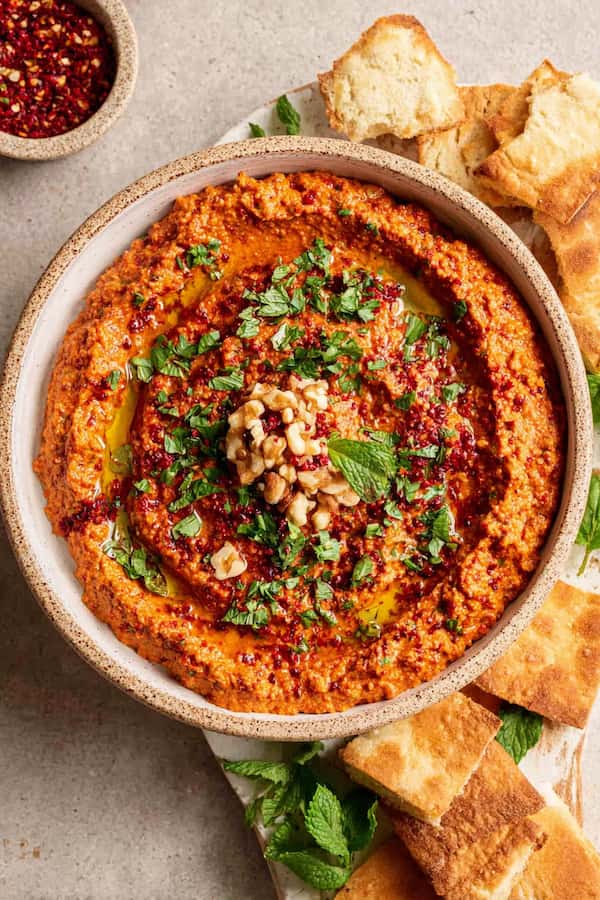
Spoon the muhammara onto a wide plate or shallow bowl and spread it using the back of a spoon. Drizzle olive oil over the surface — be generous. Scatter a small handful of roughly chopped toasted walnuts on top, a pinch of Aleppo pepper for color and heat, and a few flat parsley leaves. Serve with warm pita or flatbread alongside.
Muhammara is also a good sauce for grilled chicken, lamb chops, or roasted cauliflower. It works as a pasta sauce thinned with a little pasta water, or as a spread on a grain bowl. The flavor holds up to strong ingredients and works in savory contexts beyond just dipping.
How To Make This Muhammara Recipe Better
These changes refine the recipe or take it in a slightly different direction:
Use Aleppo pepper if you can find it. Regular red pepper flakes work as a substitute but Aleppo is milder, fruitier, and less sharp. It’s the traditional spice in muhammara and the flavor is noticeably different — worth ordering online if your local store doesn’t carry it.
Add a tablespoon of tahini. It adds a sesame depth that blends well with the walnut and softens the Aleppo heat slightly. This version sits closer to a hybrid between muhammara and a red pepper hummus — still very good.
Roast the garlic instead of using it raw. Roasting mellows the garlic completely and removes the sharpness that raw garlic can add. Squeeze two or three cloves from a roasted head and blend them in — the flavor is sweeter and more cohesive with the peppers.
Make it spicier with fresh chili. Add half a seeded fresh red chili or a small amount of harissa paste to the food processor for a version with more heat that builds differently than Aleppo pepper.
Serve it warm. Muhammara is often served at room temperature but warming it gently in a small pan with a drizzle of olive oil changes the character — the walnut oils come forward and the whole dip tastes richer. Serve warm with bread for dipping and a cold yogurt alongside.
Storage
Store muhammara in an airtight container in the fridge for up to 5 days. The flavor actually improves after a day as the ingredients continue to meld. A thin layer of olive oil over the surface before sealing helps preserve it and keeps the top from drying out. Bring to room temperature before serving — cold muhammara is denser and less flavorful than it is at room temperature. It also freezes well for up to 2 months — freeze in a sealed container and thaw overnight in the fridge. Stir well and add a fresh drizzle of olive oil before serving from frozen.
What Is Pomegranate Molasses and Can You Substitute It?
Pomegranate molasses is a thick, dark syrup made from reduced pomegranate juice — intensely tart and slightly sweet, with a fruity depth that’s unlike any other pantry ingredient.
It’s widely used in Levantine and Persian cooking and is the ingredient in muhammara that makes the flavor hard to place. You can find it at Middle Eastern grocery stores, Whole Foods, and increasingly in regular supermarkets. If you can’t find it, the closest substitute is a mix of one tablespoon of balsamic vinegar and half a teaspoon of honey — it doesn’t have the same pomegranate character but gives you a similar sweet-sour balance.
Tamarind paste thinned with a little water is another option that captures more of the fruity acidity. The recipe works with substitutes but pomegranate molasses is worth tracking down for the authentic flavor.
What Do You Eat Muhammara With?
Warm pita or flatbread is the traditional pairing and the most straightforward way to eat it. On a mezze table it sits naturally alongside hummus, labneh, and olives. Beyond dipping, muhammara works as a sauce for grilled or roasted meat — it pairs particularly well with lamb, chicken, and beef. Spread it on a sandwich or wrap instead of a standard condiment.
Use it as a pizza sauce base under mozzarella. Toss it through pasta with a splash of pasta water and a handful of parmesan. Spoon it over roasted cauliflower or eggplant as a finishing sauce. Thin it further with olive oil and use it as a salad dressing over a grain bowl. The bold flavor holds up to strong ingredients and makes plain things taste interesting.
Muhammara is the dip that surprises people who haven’t tried it before. Make it once for a gathering and it becomes the recipe someone asks for every time after. The ingredients are simple — the balance is what takes it somewhere interesting.
Ingredients
Method
- Place whole red peppers directly over a gas flame, turning with tongs until charred on all sides — about 8–10 minutes. Or broil on a baking sheet at high heat for 20–25 minutes, turning once. Transfer to a bowl, cover with plastic wrap, and steam for 15 minutes. Peel off the skins, remove stems and seeds. Do not rinse. If using jarred peppers, drain and pat dry.
- Spread walnuts in a dry skillet over medium heat. Stir frequently for 3–4 minutes until fragrant and slightly darker. Remove immediately and let cool.
- Add roasted peppers, toasted walnuts, breadcrumbs, pomegranate molasses, lemon juice, garlic, Aleppo pepper, cumin, smoked paprika, and salt to a food processor. Pulse to break down roughly, then process on high for 30 seconds. With the processor running, drizzle in olive oil slowly. Scrape down the sides and process 20–30 seconds more. The dip should have texture — not completely smooth.
- Taste and balance — add more lemon juice if too sweet, more pomegranate molasses if too sharp, more Aleppo pepper for heat. Add water 1 tablespoon at a time if too thick. Rest 10 minutes before serving.
- Spread onto a plate, drizzle generously with olive oil, scatter chopped walnuts, Aleppo pepper, and parsley on top. Serve with warm pita or flatbread.
Notes
- Don’t rinse roasted peppers — you’ll wash away flavor
- Toast walnuts fresh — raw walnuts produce a flatter, less nutty flavor
- Aleppo pepper is worth finding — milder and fruitier than regular chili flakes
- Pomegranate molasses substitute: 1 tablespoon balsamic vinegar + 1/2 teaspoon honey
- Keeps in the fridge for up to 5 days — flavor improves after day one
- Freezes well for up to 2 months — thaw overnight and stir before serving
- Bring to room temperature before serving — cold muhammara is less flavorful