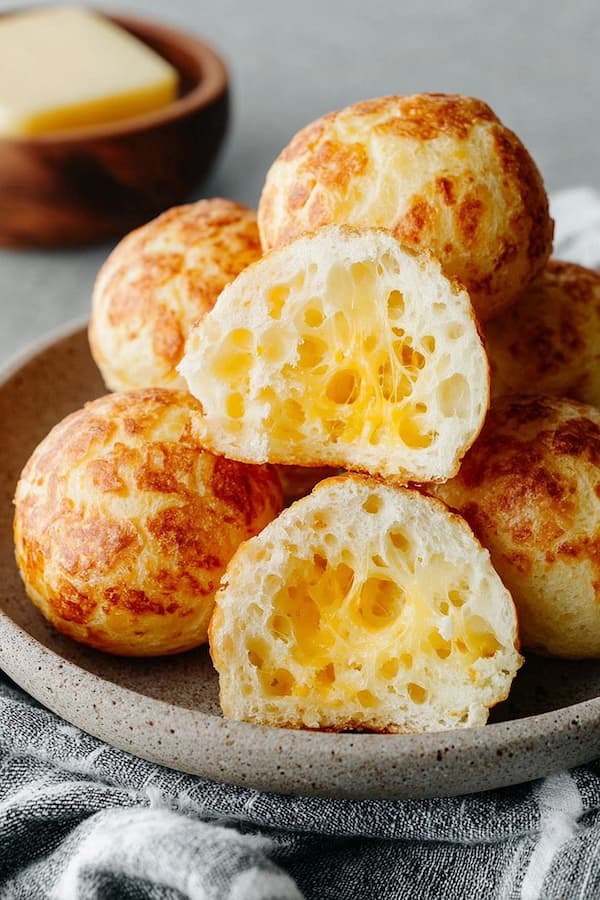
Brazilian cheese bread — known as pão de queijo — is a gluten-free cheese puff made from tapioca starch, eggs, milk, oil, and cheese that bakes into something golden on the outside, hollow and chewy inside, and impossible to stop eating once they’re warm from the oven.
The recipe comes together in one bowl with no kneading, no yeast, and no rising time — it’s one of the most forgiving bread recipes you can make.
Once you’ve had them fresh from the oven, the version sold frozen at stores stops making any sense.
Ingredients
Makes: about 24 cheese puffs (serves 6–8)
For the cheese bread:
- 2 cups tapioca starch (also called tapioca flour — not regular flour)
- 1 cup whole milk
- 1/3 cup neutral oil or melted butter
- 1 teaspoon salt
- 2 eggs, beaten
- 1 cup grated parmesan or cotija cheese
- 1/2 cup shredded mozzarella (for stretch and melt)
Why You Must Try This Brazilian Cheese Bread Recipe
Pão de queijo is different from every other cheese bread in this series because it contains no flour at all — the tapioca starch is what gives it structure and also what produces its distinctive chewy interior. When tapioca starch heats up, it gelatinizes and creates a texture that’s elastic and slightly stretchy rather than crumbly or bready.
The outside becomes golden and slightly crisp while the inside stays hollow and pulls apart in chewy strands when you break one open. It’s naturally gluten-free, the batter takes about 10 minutes to make, and the baking time is under 25 minutes.
They’re the kind of thing people reach for before they’ve even finished sitting down at the table.
Heat the Liquid First
Combine the milk, oil, and salt in a small saucepan over medium heat. Bring it just to a simmer — you want it hot but not boiling hard. Pour the hot liquid directly over the tapioca starch in a large bowl and stir immediately.
The heat partially cooks the starch as you mix, which is what creates the right consistency for the batter. The mixture will look rough and clumpy at first — that’s normal. Keep stirring until it comes together into a shaggy, slightly sticky dough.
Let it cool for 5 to 10 minutes before adding the eggs — if the dough is too hot when the eggs go in, they’ll scramble rather than incorporate smoothly.
Add Eggs and Cheese
Once the dough has cooled enough to handle comfortably, add the beaten eggs and mix well — use your hands or a wooden spoon. The dough will be sticky and will look like it might not come together, but keep working it and it will incorporate.
Add the grated parmesan and shredded mozzarella and mix until the cheese is evenly distributed throughout the dough. The finished dough should be soft, sticky, and slightly stretchy — not dry and not so wet it won’t hold a shape.
If it feels too loose, refrigerate it for 15 minutes and it will firm up slightly as the starch sets further.
Preheat and Portion
Preheat your oven to 400°F and line a baking sheet with parchment paper. Lightly oil your hands to prevent the dough from sticking and roll tablespoon-sized portions into balls — about the size of a large marble.
Place them on the parchment with at least 1.5 inches of space between each one since they spread and puff as they bake. A small cookie scoop makes this faster and keeps the sizes consistent, which means they bake evenly and finish at the same time.
Don’t flatten them — they need to be round balls going into the oven to puff properly.
Bake Until Puffed and Golden
Bake at 400°F for 20 to 25 minutes until the puffs are golden on the outside and have puffed up visibly from their original size. They’ll look like small golden balloons by the time they’re done — the tapioca starch creates steam during baking that inflates them and creates the hollow interior.
Don’t open the oven door during the first 15 minutes — the temperature drop can cause them to deflate before the structure is set. They’re done when the surface is dry-looking and golden, not pale or shiny. Some will crack slightly at the top, which is normal and expected.
Eat While Hot
Brazilian cheese bread is best eaten within 5 to 10 minutes of coming out of the oven. The exterior is at its crispest and the interior is at its stretchiest and most chewy immediately after baking — both qualities diminish as the puffs cool.
They’re traditionally eaten plain or with butter pushed into the hollow inside while still hot. They don’t need a dipping sauce but a small bowl of sour cream or the creamy avocado dip on this site both work well alongside them.
Serve directly from the baking sheet to the table and let people take them as they cool down to a temperature where they can be handled.
How To Make This Brazilian Cheese Bread Recipe Better
These adjustments improve the base recipe or change its character:
Use a blend of parmesan and sharp cheddar. Replacing the mozzarella with sharp cheddar gives the puffs a more pronounced cheese flavor with a slightly sharper, saltier note. The texture stays the same but the taste is more assertive.
Add garlic powder or dried herbs. A half teaspoon of garlic powder or dried rosemary mixed into the dough adds a flavor note that complements the cheese without changing the character of the bread. Garlic powder in particular makes these work well alongside soup or stew.
Use part sour cream, part milk. Replace half the milk with full-fat sour cream. The extra acidity from the sour cream gives the finished puffs a subtle tang and makes the interior slightly more tender.
Make larger puffs for a different texture. Roll the dough into golf ball-sized rounds instead of marble-sized. They take 5 to 7 more minutes to bake but the larger interior is more dramatically hollow and the chew is more pronounced — closer to what you’d get at a Brazilian churrascaria.
Freeze the raw dough balls. Shape the dough into balls and freeze them in a single layer on a tray, then transfer to a bag. Bake directly from frozen at 400°F for 25 to 28 minutes. This is the most practical make-ahead approach — you get fresh pão de queijo any time without any active work.
Storage
Baked pão de queijo doesn’t store particularly well — they soften significantly within an hour of baking and reheating them in the oven at 350°F for 5 minutes helps but doesn’t fully restore the original texture.
The best storage approach is to freeze the unbaked dough balls and bake them fresh whenever you want them. Frozen raw dough keeps for up to 2 months and can be baked directly from frozen with no thawing.
If you do have leftover baked puffs, store them in an airtight container at room temperature for up to 2 days and reheat before serving.
What Is Tapioca Starch and Where Can You Buy It?
Tapioca starch — also sold as tapioca flour — is a fine white powder made from the starchy root of the cassava plant. It’s the only ingredient in this recipe that you might not already have and the only one that can’t be substituted without changing the fundamental nature of the dish.
The characteristic chew of pão de queijo comes entirely from tapioca starch — regular wheat flour, cornstarch, or rice flour all behave completely differently when baked and produce either a dense, doughy result or a crumbly one.
In the US, tapioca starch is widely available at Asian grocery stores, Latin grocery stores, health food stores like Whole Foods, and online. It keeps indefinitely in a sealed container and is useful for other recipes including thickening sauces and making bubble tea.
Can You Make Pão de Queijo Without a Blender?
Yes — this recipe is written specifically for the by-hand method. Some pão de queijo recipes call for a blender to create a smoother batter, but the by-hand version in this recipe produces a slightly chewier, more textured puff that many people prefer to the blender version.
The key difference is that the by-hand method gives you a dough rather than a pourable batter, which means you roll the portions into balls rather than pouring them into a muffin tin. If you want to use a blender, add all ingredients — cold milk, oil, eggs, salt, tapioca starch, and cheese — and blend until smooth.
Pour directly into a greased mini muffin tin and bake at 400°F for 20 to 22 minutes. The blender version has a slightly lighter, more uniform texture while the hand-mixed version has more chew.
Brazilian cheese bread is the recipe that surprises people every time they try it for the first time. The ingredient list is simple, the technique is straightforward, and the result is something that has no real equivalent in any other bread tradition.
Make a double batch of raw dough balls for the freezer and you’ll have them on hand for every occasion that calls for something warm and cheesy alongside dinner.
Ingredients
Method
- Combine milk, oil, and salt in a small saucepan over medium heat. Bring just to a simmer. Pour the hot liquid over the tapioca starch in a large bowl and stir immediately until it comes together into a shaggy dough. Let cool 5–10 minutes.
- Add beaten eggs to the cooled dough and mix well with your hands or a wooden spoon until fully incorporated. Add parmesan and mozzarella and mix until evenly distributed. The dough should be soft, sticky, and slightly stretchy. If too loose, refrigerate 15 minutes to firm up.
- Preheat oven to 400°F and line a baking sheet with parchment. Lightly oil your hands. Roll tablespoon-sized portions into smooth balls and place on the tray with 1.5 inches of space between each. Do not flatten.
- Bake at 400°F for 20–25 minutes until golden and visibly puffed. Do not open the oven door during the first 15 minutes. They are done when the surface looks dry and golden, not pale or shiny.
- Eat within 5–10 minutes of coming out of the oven for the best texture. Serve plain, with butter, or alongside a dipping sauce.
Notes
- Use tapioca starch only — wheat flour, cornstarch, or rice flour will not produce the right texture
- Let the dough cool before adding eggs — hot dough will scramble them
- Do not open the oven in the first 15 minutes — the temperature drop can cause deflation before the structure sets
- Freeze raw dough balls on a tray then transfer to a bag — bake from frozen at 400°F for 25–28 minutes
- Frozen raw dough keeps for up to 2 months — the best make-ahead approach
- Baked puffs keep at room temperature for up to 2 days — reheat at 350°F for 5 minutes
- For a blender version: blend all ingredients cold until smooth, pour into a greased mini muffin tin, bake 20–22 minutes