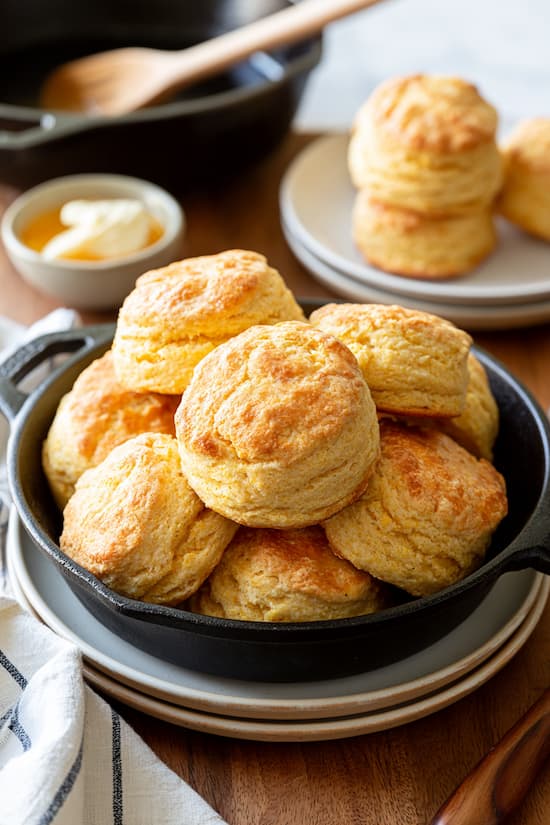
Homemade English muffins are cooked entirely on the stovetop in a cast iron pan or griddle — no oven required — which is what gives them their characteristic flat top and bottom with a soft, nook-filled interior that toasted English muffins are known for.
The dough is straightforward and the results are noticeably better than store-bought, with a chewier texture and more flavor from a longer rest time. Once you’ve made them, the packaged version starts to feel like a compromise.

Ingredients
Makes: 8 English muffins (serves 8)
For the dough:
- 2 1/4 teaspoons active dry yeast (1 packet)
- 1 teaspoon sugar
- 1 cup warm whole milk (110°F)
- 1/4 cup warm water (110°F)
- 3 cups all-purpose flour, plus more as needed
- 1 teaspoon salt
- 1 tablespoon unsalted butter, softened
- 1 egg, beaten
- Cornmeal for dusting (the classic coating that creates the texture)
- Oil or butter for greasing the pan
Why You Must Try This English Muffin Recipe
The thing that sets English muffins apart from every other bread in this series is the cooking method. They’re not baked — they’re cooked in a dry pan on both sides, which creates the flat, griddle-marked surfaces and traps air inside to create the characteristic open, nook-filled crumb.
Those nooks are what make English muffins worth making from scratch — they absorb butter, jam, or egg yolk in a way that sliced bread or rolls can’t. The cornmeal dusting on the outside is another detail that store-bought muffins rush past — it adds a faint gritty texture to the crust and contributes to the flavor in a way that’s easy to miss until it’s not there.
Activate the Yeast
Warm the milk and water together to around 110°F — warm on your wrist but not hot. Add the sugar and yeast, stir gently, and leave for 5 to 10 minutes until the surface is foamy. If nothing foams, the yeast is inactive — start again with a fresh packet.
This is the same yeast activation step used across most bread recipes in this series, and the same rule applies: don’t skip the foam check, and don’t rush it by using water that’s too hot. Yeast killed by overheating is a common reason homemade bread doesn’t rise properly.
Mix and Knead the Dough
Add the softened butter, beaten egg, and salt to the yeast mixture and stir to combine. Add the flour one cup at a time, stirring between additions until a rough dough forms.
Turn onto a lightly floured surface and knead for 8 minutes until smooth and elastic. The dough should be soft but not sticky — slightly tacky is fine, but if it’s leaving dough on your hands continuously, add a tablespoon of flour at a time.
English muffin dough is softer than a standard bread dough — don’t be tempted to add too much extra flour or the finished muffins will be dense rather than soft and open inside.
Rise and Refrigerate
Place the kneaded dough in a lightly oiled bowl, cover tightly with plastic wrap, and leave at room temperature for 1 hour until doubled in size. After that first rise, punch the dough down, re-cover, and refrigerate overnight — or for at least 8 hours.
This cold, slow fermentation is the step that separates good English muffins from great ones. The extended cold rest develops a flavor depth that a quick same-day rise can’t produce, and it also makes the dough easier to handle and shape the next morning since it’s cold and firm rather than sticky and slack.
You can skip the overnight rest and go straight from the first rise to shaping, but the flavor difference is worth planning ahead for.
Shape and Dust
Take the cold dough out of the fridge and let it sit at room temperature for 20 to 30 minutes to take the chill off. On a lightly floured surface, roll it out to about 3/4 inch thickness. Use a 3.5 to 4 inch round cutter — or the rim of a drinking glass — to cut rounds. Re-roll the scraps and cut again until all the dough is used.
Dust a baking sheet generously with cornmeal and place each round on it. Dust the tops of the rounds generously with cornmeal as well. Cover with a clean towel and let them rest for 30 to 45 minutes at room temperature until slightly puffed.
Cook on the Stovetop
Heat a cast iron skillet or griddle over the lowest possible heat — this is the key to cooking English muffins properly. The goal is slow, even heat that cooks the muffin through to the center without burning the outside.
Lightly grease the pan with a small amount of butter or oil. Place the muffins in the pan with space between each one. Cook for 7 to 8 minutes on the first side without moving — the bottom should be golden-brown with some darker spots. Flip carefully and cook for another 7 to 8 minutes on the second side.
The muffin is done when both sides are golden and it sounds hollow when you tap it. If the outside is browning too quickly, reduce the heat further — the inside needs time to cook through.
Split and Toast
Let the cooked muffins cool for at least 5 minutes before splitting. The traditional way to open an English muffin is with a fork — insert a fork all the way around the equator of the muffin and pry it apart gently.
This fork-splitting method tears the crumb rather than cutting it cleanly, which creates more surface area and more nooks to catch whatever you’re putting on it.
Toasting directly changes the texture significantly — split and toasted in the toaster or under a broiler, the interior nooks become crispy and the butter absorption is different from an untoasted muffin. Both are good but toasted is worth experiencing first.
How To Make This English Muffin Recipe Better
These changes improve the base recipe or take it in a different direction:
Use bread flour instead of all-purpose. Bread flour has a higher protein content that creates more gluten structure, which gives the finished muffin a chewier texture and more distinct nooks. The difference is noticeable — particularly in the toasted version.
Add a tablespoon of honey to the dough. It adds a very faint sweetness and helps the muffins brown more evenly in the pan. The flavor is subtle — you won’t identify it as honey, but the finished muffin tastes slightly more complex.
Make sourdough English muffins. Replace the yeast with 150g of active sourdough starter and reduce the flour slightly. Increase the rise time to 4 to 6 hours at room temperature or overnight in the fridge. The flavor is noticeably tangier and the crumb is even more open.
Add cheese to the dough. Fold 1/2 cup of finely grated cheddar or parmesan into the dough during the last minute of kneading. The cheese creates pockets of flavor inside the muffin and a slightly different crust texture.
Cook in rings for a more uniform shape. If you want perfectly round, even muffins, place buttered egg rings or cookie cutters in the pan and cook the muffins inside them. Remove the rings when the muffins are set enough to hold their shape — usually after the first 4 to 5 minutes.
Storage
Store cooked English muffins in an airtight bag at room temperature for up to 3 days or in the fridge for up to a week. They freeze exceptionally well for up to 3 months — split them before freezing and you can toast them directly from frozen without thawing. Freeze in a zip-lock bag in a single layer or with parchment between each half.
The uncooked shaped muffin rounds can also be frozen before the second rise — freeze on a tray until solid, then bag. Thaw overnight in the fridge, rest at room temperature for 30 minutes, and cook as directed.
Why Do English Muffins Have Nooks and Crannies?
The nooks and crannies in English muffins come from a combination of factors. The relatively wet dough creates large, irregular air bubbles during fermentation.
When the muffin is cooked slowly in a pan rather than baked in an oven, the exterior sets before the interior has fully risen, which traps those air bubbles in place rather than letting them smooth out as they would in oven heat.
The fork-splitting method opens the muffin along those existing air channels rather than cutting through them — which is why knife-cut English muffins always look smoother and have fewer nooks than fork-split ones.
A longer fermentation — particularly the overnight cold rest — also produces larger, more irregular bubbles, which is why extended fermentation time directly affects how nook-filled the finished muffin is.
Why Is Cornmeal Used on English Muffins?
Cornmeal serves two practical purposes. First, it prevents the raw dough rounds from sticking to the baking sheet during the second rise, since English muffin dough is soft and would stick to an undusted surface.
Second, it stays on the surface during cooking and creates the distinctive slightly gritty texture on the top and bottom crust that English muffins are known for.
It also contributes a subtle corn flavor that is part of the characteristic taste of an English muffin — which is why store-bought muffins list cornmeal in their ingredients. Some recipes use semolina or rice flour as substitutes, both of which provide the non-stick function but with slightly different textures. Cornmeal is the traditional choice and produces the most recognizable result.
Homemade English muffins are one of those projects that seem more involved than they are. The actual hands-on time is short — most of the time is just waiting. Make the dough one evening, cook the next morning, and you have English muffins that make every breakfast option that requires them significantly better.

Ingredients
Method
- Combine warm milk, warm water, sugar, and yeast in a large bowl. Stir gently and leave 5–10 minutes until foamy. If no foam forms, start over with fresh yeast.
- Add softened butter, beaten egg, and salt to the yeast mixture. Add flour one cup at a time, stirring between additions. Turn onto a lightly floured surface and knead 8 minutes until smooth and elastic. Dough should be soft and slightly tacky — do not add too much extra flour.
- Place dough in a lightly oiled bowl, cover tightly with plastic wrap, and leave at room temperature for 1 hour until doubled.
- Punch dough down, re-cover, and refrigerate for at least 8 hours or overnight. This cold fermentation develops flavor and makes the dough easier to handle.
- Remove dough from fridge and rest at room temperature 20–30 minutes. Roll to 3/4 inch thickness on a lightly floured surface. Cut rounds using a 3.5–4 inch cutter. Place on a cornmeal-dusted tray and dust tops generously with cornmeal. Cover and rest 30–45 minutes until slightly puffed.
- Heat a cast iron skillet or griddle over the lowest heat. Lightly grease with butter or oil. Cook muffins 7–8 minutes per side until golden-brown on both sides and hollow-sounding when tapped. Do not rush with high heat — the inside needs time to cook through.
- Cool 5 minutes. Split with a fork around the equator for maximum nooks. Toast and serve with butter, jam, or eggs.
Notes
- Overnight cold rest is strongly recommended — it develops flavor and open crumb structure
- Use the lowest heat setting — high heat browns the outside before the inside cooks through
- Fork-split rather than knife-cut for more nooks and better butter absorption
- Freeze split muffins for up to 3 months — toast directly from frozen
- Use bread flour instead of all-purpose for a chewier texture and more distinct nooks
- Cook in buttered egg rings for perfectly round, even muffins
- Sourdough version: replace yeast with 150g active starter, increase rise time to 4–6 hours