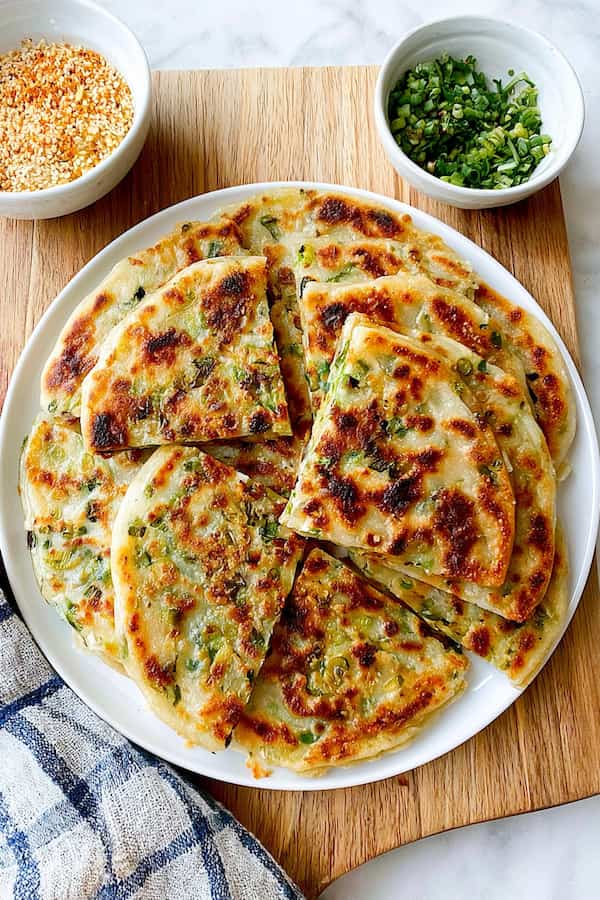
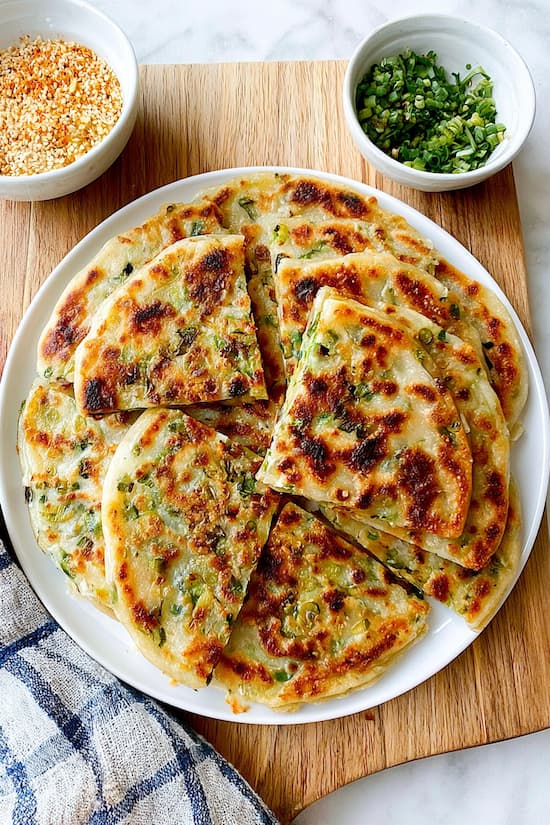
Scallion pancakes — called cong you bing in Chinese — are flaky, layered flatbreads made by rolling oil and scallions into a simple flour dough, coiling it, and pan-frying until golden with slightly crispy edges and a chewy interior.
The layered texture comes from a technique similar to making croissants or puff pastry, except far simpler — no butter, no chilling, no complicated folding.
They’re one of the most satisfying things you can make from a nearly empty pantry and they come with a dipping sauce that makes everything better.
Ingredients
Makes: 4 pancakes (serves 4 as a side or snack)
For the dough:
- 2 cups all-purpose flour, plus more for dusting
- 3/4 cup boiling water
- 1/2 teaspoon salt
- 1 teaspoon sesame oil (optional, adds flavor to the dough)
For the filling:
- 4 tablespoons neutral oil (for brushing)
- 1 teaspoon sesame oil
- 1/2 teaspoon salt
- 6 scallions (spring onions), finely sliced — about 1 cup
For the dipping sauce:
- 3 tablespoons soy sauce
- 1 tablespoon rice vinegar
- 1 teaspoon sesame oil
- 1 teaspoon sugar
- 1/2 teaspoon chili flakes or chili oil (optional)
- 1 clove garlic, finely grated
- 1 teaspoon toasted sesame seeds
Why You Must Try This Scallion Pancakes Recipe
Scallion pancakes are different from every other flatbread in this series because the layered texture comes from a specific rolling and coiling technique rather than yeast, baking powder, or a fryer.
The hot water used for the dough partially cooks the starch in the flour, which makes it softer and more pliable than cold water dough and produces that distinctive chewy-yet-flaky texture when cooked.
The scallions are locked between the layers during the coiling process, so every bite has green onion distributed throughout rather than sitting on the surface.
The dipping sauce is worth making even if you’re serving these with something else — soy, rice vinegar, sesame oil, and garlic is a combination that works with almost anything.
Make the Hot Water Dough
Combine the flour and salt in a large bowl. Pour the boiling water in gradually, stirring with a fork or chopsticks as you go. The water needs to be genuinely boiling — not just hot — to partially gelatinize the starch and give the dough its characteristic soft, pliable texture.
Once the mixture is shaggy and cool enough to handle, knead it by hand for 3 to 4 minutes until smooth. The dough should feel soft and slightly springy — not tacky, not stiff. Cover with plastic wrap or a damp towel and rest for 30 minutes.
The rest period is not optional — it lets the gluten relax so the dough rolls thin without snapping back.
Roll, Oil, and Scatter
Divide the rested dough into 4 equal pieces. On a lightly floured surface, roll one piece as thin as you can — aim for roughly 10 to 12 inches in diameter, about 1 to 2mm thick.
The thinner you roll it, the more distinct the layers will be in the finished pancake. Mix the neutral oil with the sesame oil and brush a thin layer over the entire surface of the rolled dough.
Sprinkle evenly with a pinch of salt and scatter a generous layer of sliced scallions across the surface — use about a quarter of the scallions per pancake. Press them gently into the oiled surface so they adhere rather than falling out during the next steps.
Roll, Coil, and Press
Starting from one edge, roll the dough tightly into a long cylinder — like rolling a yoga mat.
You’ll see the scallions inside as you roll. Once you have a long cylinder, coil it tightly into a snail shape, tucking the end underneath. Press the coil down firmly with your palm to flatten it.
Then use a rolling pin to roll it out again into a flat round about 6 to 7 inches in diameter and about 1/4 inch thick.
This coiling and re-rolling step is what creates the layers — the oil and scallions are now locked between spiraling layers of dough that will separate as the pancake cooks. Repeat with the remaining pieces.
Fry Until Layered and Golden
Heat 1 tablespoon of neutral oil in a non-stick or cast iron pan over medium heat. Add one pancake and cook for 3 to 4 minutes on the first side without moving it, until the bottom is golden-brown in patches with some darker spots.
Flip and cook for another 2 to 3 minutes on the second side. You can press down gently with a spatula to ensure even contact with the pan. The pancake is done when both sides are golden, the edges look slightly crisp, and the pancake has puffed very slightly in places — those puffed spots indicate the layers have separated during cooking.
Add more oil between each pancake as needed.
Make the Dipping Sauce and Serve
While the pancakes cook, stir together the soy sauce, rice vinegar, sesame oil, sugar, chili flakes, grated garlic, and sesame seeds in a small bowl. Taste and adjust — if it’s too sharp, add a little more sugar or sesame oil.
If it tastes flat, a splash more rice vinegar sharpens it. Cut the cooked pancakes into wedges while still warm and serve immediately with the dipping sauce on the side. The texture changes as they cool, becoming chewier and less flaky, so eat them as close to frying as possible.
How To Make This Scallion Pancakes Recipe Better
These changes improve the technique or shift the flavor:
Use lard or schmaltz instead of neutral oil for the filling. Both have more flavor than vegetable oil and are traditionally used in Chinese scallion pancakes. The difference in flavor between lard and neutral oil in this application is noticeable.
Add a thin layer of toasted sesame seeds to the filling. Scatter them over the oiled surface with the scallions before rolling. They distribute through the layers and add a mild nutty flavor and occasional crunch.
Rest the shaped coils before frying. After the final roll and shaping, let the pancakes rest for 10 minutes before they go into the pan. The gluten relaxes further and the layers separate more distinctly during cooking.
Add five spice or white pepper to the filling oil. A small pinch of either spice mixed into the oil before brushing adds a subtle warmth that lifts the whole pancake without being identifiable as a specific flavor.
Crumble the cooked pancake before serving. After frying, smash the pancake firmly with your hands or a spatula to break it apart slightly. This technique, popular in Taiwan, creates more surface area and gives each piece a more irregular, crispy texture on the edges.
Storage
Scallion pancakes are best eaten immediately after frying. Like most fried flatbreads, the texture starts to change within 15 to 20 minutes as they cool. Leftover cooked pancakes can be reheated in a dry pan over medium heat for 2 minutes per side — they won’t be as good as fresh but they’re still worth eating. Uncooked shaped pancakes — after the final roll — freeze well.
Stack them between sheets of parchment paper in a freezer bag and freeze for up to 2 months. Cook directly from frozen in an oiled pan over medium-low heat for 5 to 6 minutes per side.
The raw dough before shaping can also be refrigerated for up to 24 hours, wrapped tightly.
Why Is Boiling Water Used Instead of Cold?
The boiling water is what gives scallion pancake dough its characteristic texture. When boiling water is added to flour, it partially cooks the starch — a process called gelatinization — which breaks down some of the gluten structure and makes the dough softer, more pliable, and easier to roll thin without tearing.
Cold water dough has more gluten tension and snaps back when you try to roll it thin, which makes it difficult to get the layers thin enough for a properly flaky result. The hot water dough also produces a softer finished pancake rather than a crispy, cracker-like one.
It’s the same principle used in other Chinese wheat-based doughs like dumpling wrappers — the ratio of hot to cold water adjusts the final texture.
Can You Make Scallion Pancakes Without a Rolling Pin?
Yes. A wine bottle or a tall drinking glass works as a substitute rolling pin for this recipe. The dough is soft and cooperative after resting, so it doesn’t require the precision of a traditional rolling pin to get thin.
You can also use your hands — press the coil flat with your palm first, then stretch and press with your fingers, working from the center outward. The pancake won’t be perfectly round but the layers will still form and the flavor will be the same. A smooth-bottomed glass or bottle rolls more evenly than one with seams, so that’s worth considering if you’re using a substitute.
The most important thing is getting the dough thin enough — how you get there is less important than the result.
Scallion pancakes are a recipe where the technique is the whole point. Once you understand the roll-oil-scatter-coil-press sequence, you can make them without thinking. Get the dough thin, oil it properly, and let the pan do the rest.
Ingredients
Method
- Combine flour and salt in a bowl. Pour boiling water in gradually, stirring with a fork. Once cool enough to handle, knead 3–4 minutes until smooth. Cover and rest 30 minutes.
- Divide dough into 4 pieces. Roll one piece as thin as possible — about 10–12 inches in diameter. Mix neutral oil with sesame oil and brush over the surface. Sprinkle with salt and scatter scallions evenly. Press gently to adhere.
- Roll dough tightly into a cylinder from one edge. Coil the cylinder into a snail shape and tuck the end underneath. Press flat with palm, then roll out again into a 6–7 inch round about 1/4 inch thick. Repeat with remaining pieces.
- Heat 1 tablespoon oil in a non-stick or cast iron pan over medium heat. Cook pancake 3–4 minutes on first side until golden-brown. Flip and cook 2–3 more minutes. Press gently for even contact. Repeat with remaining pancakes, adding oil as needed.
- Stir together all dipping sauce ingredients. Taste and adjust. Cut pancakes into wedges and serve immediately with dipping sauce.
Notes
- Use genuinely boiling water — not just hot — to partially cook the starch and create the soft, pliable dough
- Rest the dough for 30 minutes — skipping this makes rolling difficult
- Roll as thin as possible — thinner rolling = more distinct layers
- The puffed spots in the finished pancake mean the layers have separated correctly
- Freeze uncooked shaped pancakes between parchment sheets for up to 2 months — cook from frozen over medium-low for 5–6 minutes per side
- Reheat leftovers in a dry pan 2 minutes per side