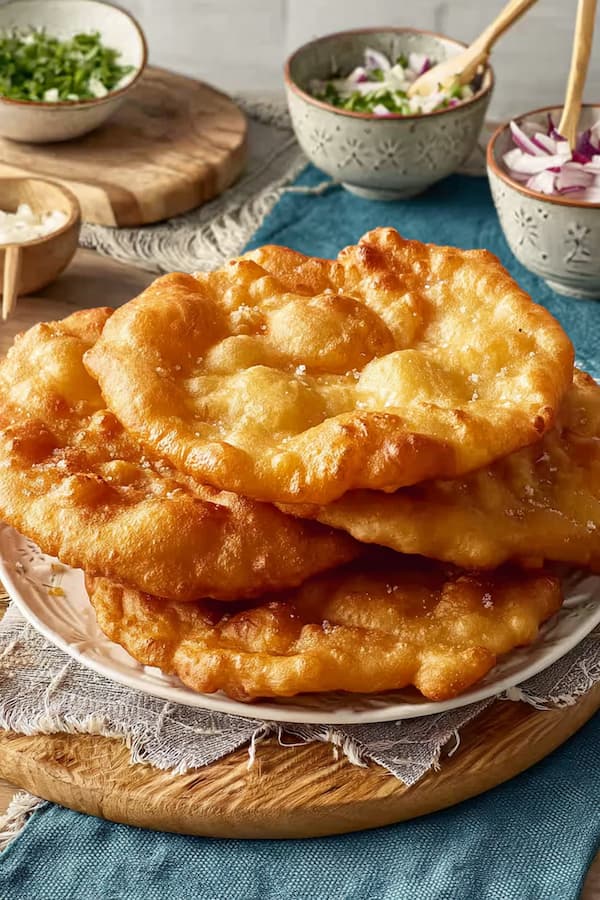
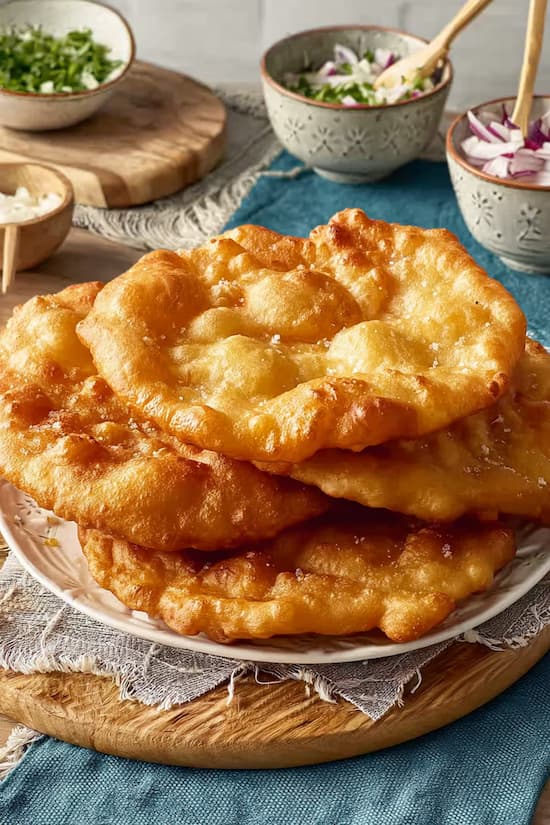
Langos is a Hungarian deep-fried flatbread made from a simple yeast dough that puffs up in hot oil into something golden, airy, and slightly chewy — eaten immediately from the fryer, usually rubbed with garlic and topped with sour cream and grated cheese.
It’s one of the most popular street foods across Hungary and Central Europe, sold at markets and fairs year-round. Once you’ve had one fresh from the oil, no other flatbread quite compares.
Ingredients
Makes: 6 langos (serves 4–6)
For the dough:
- 2 1/4 teaspoons active dry yeast (1 packet)
- 1 teaspoon sugar
- 1 cup warm whole milk (about 110°F)
- 2.5 cups all-purpose flour, plus more for dusting
- 1 teaspoon salt
- 1 tablespoon neutral oil (for the bowl)
- Vegetable oil for deep frying (enough for 2–3 inches depth)
For the classic toppings:
- 3 cloves garlic, finely grated or minced
- 2 tablespoons olive oil (mixed with the garlic for rubbing)
- 1 cup sour cream
- 1.5 cups shredded sharp cheddar or gruyere
- Flaky sea salt
Why You Must Try This Langos Recipe
Langos occupies a category of its own. It’s not a doughnut, not a flatbread in the usual sense, and not a fritter — it’s something between all three, with a texture that’s hard to replicate by any other cooking method.
The dough is yeasted and light, so when it hits hot oil it puffs immediately and the inside becomes airy while the outside turns deep golden and slightly crisp. The garlic rubbed on while still hot sinks into the surface rather than sitting on top, and the sour cream and cheese combination is the kind of simple, direct topping that works because each element is doing exactly the right thing.
You can make them at home with a standard pot of oil and a kitchen thermometer.
Start the Dough
Warm the milk to around 110°F — it should feel warm on your wrist but not hot. Combine it with the sugar and yeast in a large bowl and stir gently. Leave for 5 to 10 minutes until foamy on the surface. This foam tells you the yeast is active and the dough will rise properly.
If nothing happens, start again with fresh yeast. Once the yeast is ready, add the salt and flour. Stir with a wooden spoon until a rough dough forms, then use your hands to bring it together.
The dough for langos should be softer than bread dough — slightly sticky and a little shaggy. Don’t add too much extra flour or the langos will be dense rather than airy after frying.
Knead and Rise
Turn the dough onto a lightly floured surface and knead for 5 to 6 minutes until smooth and elastic. It will feel slightly tacky — that’s correct. Resist adding a lot of extra flour. A wetter langos dough produces a lighter, more open texture inside after frying.
Shape it into a ball, place it in a lightly oiled bowl, cover with plastic wrap or a clean towel, and leave in a warm spot to rise for 1 hour until doubled in size. A turned-off oven with only the light on is a reliable warm spot. Don’t rush the rise — the yeast activity during this time develops the flavor and the gas bubbles that make the langos light when it hits the oil.
Shape and Rest
Punch the risen dough down and divide it into 6 equal portions. On a lightly floured surface, stretch or roll each piece into an oval or round shape about 6 to 7 inches across and roughly 1/4 inch thick. Don’t make them too thin — the dough needs some thickness to puff properly in the oil.
Traditional langos are stretched by hand rather than rolled, which creates slight variations in thickness that give the finished bread its characteristic uneven, bubbly surface. Lay the shaped pieces on a floured tray and cover with a towel. Let them rest for 15 minutes before frying.
This short rest lets the gluten relax, which makes the dough easier to handle and helps it puff more evenly in the oil.
Fry in Hot Oil
Pour enough vegetable oil into a large, deep pot to reach 2 to 3 inches deep. Heat to 350 to 360°F — use a thermometer for accuracy. Carefully lower one piece of dough into the oil. It should puff up within seconds and start bubbling actively around the edges.
Fry for 2 to 3 minutes on the first side until deep golden brown, then use tongs or a slotted spoon to flip and fry for another 1 to 2 minutes on the second side. The second side usually takes less time since the dough is already hot. Remove to a wire rack or paper towels to drain.
Let the oil come back to temperature between each langos — frying in oil that’s too cool produces a greasy, dense result.
Top and Eat Immediately
Mix the grated garlic with olive oil in a small bowl. While the langos is still hot from the fryer, rub the garlic oil over the surface — the heat pulls the garlic into the bread rather than leaving it sitting on top.
Spread a generous spoonful of sour cream over the garlic surface. Scatter shredded cheese liberally over the sour cream. Finish with a pinch of flaky sea salt. Eat immediately.
Langos doesn’t hold — it starts to lose its crispness and lightness within minutes of coming out of the oil, which is why it’s street food rather than something you make ahead. Fry one at a time if needed and serve each one directly to whoever is waiting.
How To Make This Langos Recipe Better
These changes take the recipe in different directions:
Add mashed potato to the dough. Replacing about a third of the flour with mashed potato makes the langos softer and slightly denser inside with a more complex flavor. It’s a traditional variation used across Hungary and gives the bread a different character from the plain flour version.
Use Greek yogurt instead of sour cream. Full-fat Greek yogurt is slightly tangier and thicker than sour cream, which means it stays on the langos better without sliding off. The flavor difference is subtle but worth trying.
Add smoked cheese to the topping. Swap plain cheddar for a smoked cheese — smoked gouda or smoked mozzarella both work. The smokiness pairs particularly well with the garlic and the fried dough in a way that plain cheese doesn’t.
Make them sweet. Skip the garlic and cheese and top the hot langos with powdered sugar, Nutella, or jam instead. Sweet langos is just as popular as the savory version at Hungarian markets — it’s a different dish using the same base.
Add herbs to the dough. Knead a tablespoon of finely chopped fresh dill, parsley, or chives into the dough before the first rise. The herbs distribute through the dough and come through in each bite alongside the garlic topping.
Storage
Langos doesn’t store once cooked — eat them immediately. The texture change within 15 to 20 minutes of frying is significant enough that reheating is rarely worth it. The raw dough, however, keeps well.
You can refrigerate the risen dough for up to 24 hours — it will continue a slow, cold fermentation that actually improves the flavor. Shape and fry it cold, straight from the fridge, adding a minute to the frying time.
You can also freeze the raw dough after the first rise, tightly wrapped, for up to 1 month. Thaw overnight in the fridge, bring to room temperature for 30 minutes, then shape and fry.
What Is Langos and Where Does It Come From?
Langos is a Hungarian fried flatbread with roots going back centuries, originally made from leftover bread dough that was flattened and fried in lard. The name comes from the Hungarian word for flame — lángos — which refers to the original method of cooking it close to an open fire.
It became a staple street food across Hungary and spread throughout Central and Eastern Europe, particularly at outdoor markets, fairgrounds, and sports events.
In Hungary today it’s most commonly eaten topped with sour cream and shredded cheese, though regional variations and personal preference mean the toppings vary widely.
Outside Hungary it’s become known in other Central European countries under different names — kürtőskalács is sometimes confused with it but is a completely different spiral pastry. Langos remains one of the most recognizable and beloved foods in Hungarian street food culture.
Can You Make Langos Without Yeast?
There are yeast-free versions of langos that use baking powder as the leavening agent instead, and they’re faster since there’s no rise time. The texture is different — less airy and open, more like a thick fried pancake than the puffy, chewy result you get with yeasted dough.
If you’re short on time, mix 2 cups of flour with 1.5 teaspoons of baking powder, 1/2 teaspoon salt, and enough plain yogurt or sour cream to form a soft dough — about 3/4 cup. Rest 10 minutes, shape, and fry the same way. The flavor is simpler and the texture is denser, but the general idea is the same.
Most people who have tried both prefer the yeasted version — the extra hour for the rise produces a noticeably better result that’s worth planning ahead for.
Langos is the kind of recipe that makes people who have only heard of it suddenly understand why people talk about it the way they do. Make it once, eat it immediately from the oil with garlic and sour cream and cheese, and you’ll get it right away.
Ingredients
Method
- Combine warm milk, sugar, and yeast in a large bowl. Stir and leave 5–10 minutes until foamy. If no foam forms, start over with fresh yeast.
- Add salt and flour to the yeast mixture. Stir until a rough dough forms, then knead by hand on a lightly floured surface for 5–6 minutes until smooth and elastic. The dough should be slightly tacky — do not add too much extra flour. Place in an oiled bowl, cover, and rise in a warm spot for 1 hour until doubled.
- Punch dough down and divide into 6 equal portions. Stretch or roll each into an oval or round about 6–7 inches wide and 1/4 inch thick. Place on a floured tray, cover, and rest 15 minutes.
- Heat vegetable oil in a large deep pot to 350–360°F. Lower one piece of dough carefully into the oil. Fry 2–3 minutes until deep golden, flip, and fry 1–2 minutes more on the second side. Drain on a wire rack or paper towels. Return oil to temperature before each new langos.
- Mix grated garlic with olive oil. While langos is still hot, rub garlic oil over the surface. Spread sour cream generously on top. Scatter shredded cheese over the sour cream. Add flaky salt. Serve and eat immediately.
Notes
- Keep the dough slightly tacky — too much flour produces a dense result after frying
- Hand-stretch rather than roll for the traditional uneven, bubbly surface
- Rest shaped pieces 15 minutes before frying — it helps them puff more evenly
- Rub garlic while still hot so it absorbs into the surface rather than sitting on top
- Oil temperature matters — use a thermometer and return to 350°F between each langos
- Eat immediately — texture deteriorates within 15–20 minutes of frying
- Raw dough keeps in the fridge for up to 24 hours — shape and fry cold, adding 1 extra minute
- Freeze raw risen dough for up to 1 month — thaw overnight in fridge before shaping